
Advanced Design Studio, Beeby

522b

Credits: 
9
Term: 
Spring 2009
Instructor(s): 
Beeby, Thomas H.

I. Program

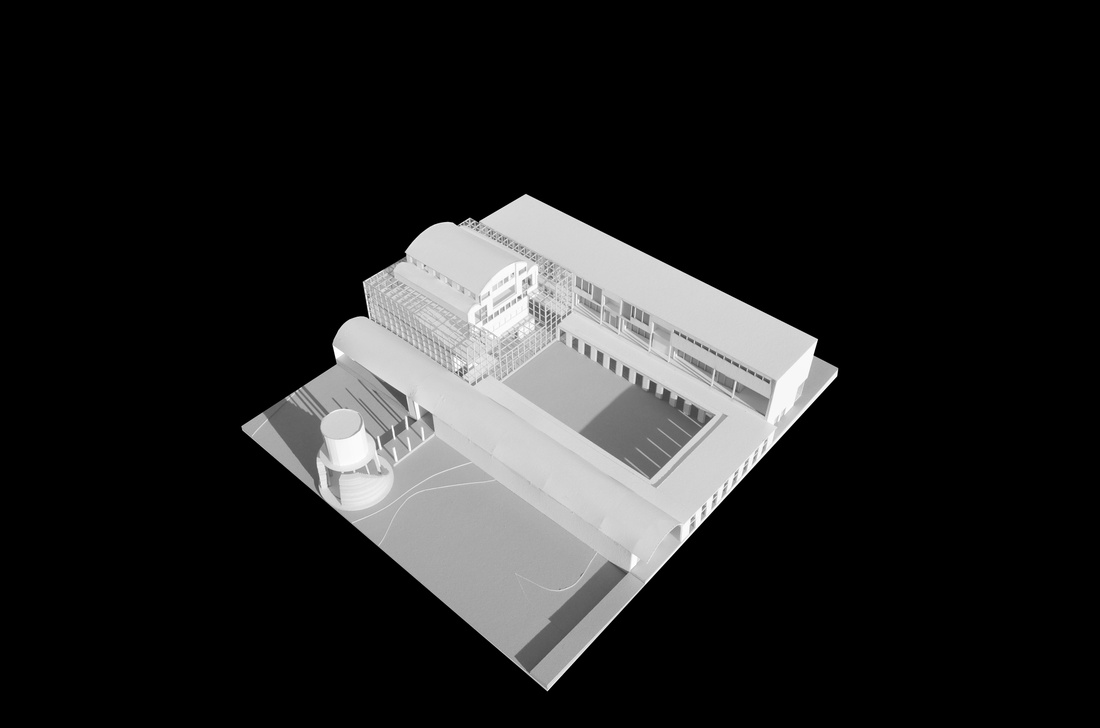
The School of Architecture at the Illinois Institute of Technology in Chicago is planning to construct a new building next to Crown Hall in order to satisfy the unprecedented growth of the school over the last decade. The required space needs will have to be accommodated within a building envelope proposed by Mies van der Rohe in his final campus plan of 1940. The foundations for a structure at this site were completed at the time of the construction of the Chemical Engineering and Metallurgy Building in 1946 and subsequently buried shortly thereafter due to inadequate funding.
 
The school’s spatial needs have currently expanded well beyond the confines of Crown Hall with students now occupying 3 buildings. The faculty and administration of the school would prefer to see it housed in one structure again with Crown Hall becoming a museum and exhibition space dedicated to architectural exhibits and the Mies van der Rohe archive.
 
The school’s programmatic needs are formed to a large degree, (as are all architectural programs in this country), by the demands of the NAAB, the accrediting body that regulates architectural education. The functions and spatial distribution of the Yale Architecture School are an adequate measure of the needs of the School of Architecture at the Illinois Institute of Technology. The school would like as much space as possible to meet their needs but is limited by the university’s funding ability and the site restrictions imposed by the building envelope proposed by Mies.

II. Site

The site is bounded on the south by Crown Hall (1956), Mies van der Rohe. To the north across State Street is located the new student union (2006), Rem Koolhaas. The northern and western limits of the site are formed by three earlier buildings by Mies; the Chemical Engineering and Metallurgy Building and the Lewis Institute and Chemistry Building to the west. The entire campus is considered to be an architectural site of the highest importance and is protected by landmark designation.

III. Intention

The studio is structured to consider change in relation to architectural thought. Both the “Shape of Time” by George Kubler and the “Anxiety of Influence” by Harold Bloom deal with issues that relate to creative responses to brilliant artistic ancestors. Each student in this studio will be expected to be conversant in the architecture of Mies van der Rohe by the end of the semester. In addition the origins of Mies’ architectural legacy will be a source of discussion during this studio. These topics will include the architecture of Chicago, the architecture of Karl Friedrich Schinkel and Peter Behrens as well as contemporaries of Mies van der Rohe such as Gerrit Rietveld, Theo van Doesburg and Piet Mondrian. Finally the student union of Rem Koolhaas will be discussed in its response to the architecture of Mies van der Rohe.

IV. Requirements

 
A. Juries
There will be a mid-term and final jury in this studio.
 
B. Travel
There will be a trip to Chicago to familiarize the students with both the IIT campus and the architectural school. The architectural culture of Chicago will also be made apparent by trips to significant buildings and sites within the Chicago area including works by Sullivan, Wright, Mies and others.
 
C. Theoretical Position
At the beginning of the studio, each student will be asked to formulate an exact intellectual position, (in relation to their professional evolution), to current architectural theory and past theoretical formulations that account for the organization of their building and its subsequent appearance. All critical discussion of the schemes will be in response to these stated initial positions.
 
D. Architectural Program
The program is based on the school’s experience in Crown Hall. One half of the required space will be open “universal space”, the other one half will be “closed space” that is partitioned for all uses not readily accommodated in open format.
 
E. Structural Restriction
Caissons are currently in place at 24’-0” on center to match the Chemical Engineering and Metallurgy Building and can support a steel frame for a two story structure over a concrete basement. New structure can be any configuration that bears on existing supports through direct alignment or through the use of transfer beams.
 
F. Building Envelope
The proposed design must touch the original building envelope at least once on each of its six surfaces. The volume of the design must equal the original volume created by Mies in his master plan.
 
G. Buildability
The completed work will be designed to be built. This fact will be immediately apparent from the drawings that are submitted for review that should include enough detail to evaluate the design as a constructed building.