Advanced Design Studio: Berke

New Fruits: Urban Distillery

1118b

Credits: 
9
Faculty: 
Additional Instructor(s): 

"Thus we have the American grain elevators and factories, the magnificent FIRST-FRUITS of the new age." - Le Corbusier, Towards a New Architecture, 1927.

“Too much of anything is bad, but too much of good whiskey is barely enough.” - Mark Twain

In this studio we will design a contemporary bourbon distillery in downtown Louisville, Kentucky.

The distillery shares an architectural lineage with the early 20th century grain elevators and agricultural buildings of the American landscape which architects used as literal models to craft a nascent Modern form. This studio will reckon with the idealization of industrial architecture as a potential site for innovation. We'll approach the distillery as a prototype for how to insert small urban manufacturing into the contemporary American city.

Louisville takes bourbon seriously. During the 19th century it was a major trade center for the spirits industry, a place where bourbon was produced, but also blended, stored, bottled, shipped, and, consumed. While as recently as the 1960s, the industrial workforce in Louisville made up more than 40% of area workers, today that workforce hovers around 10%. Like other cities in the U.S. that have faced massive deindustrialization, Louisville now relies on service industries. There are, however, notable signs that urban manufacturing is reemerging in cities in the form of small, agile companies that compete and collaborate as part of decentralized interdependent regional networks. This studio takes as its premise that small urban manufacturing offers an opportunity to rethink the 21st century American city as a place where things are made. Can a reconceived understanding of urban manufacturing—with all its messy realities—become integral to how we think about the future growth of cities?

The majority of bourbon production is centered in and around a few towns in northwest Kentucky. Although a major global business, the image of bourbon is laden with nostalgia for the bygone era of the prohibition speakeasy, the backwoods still, and the rugged individualist narrative of the American Midwest, exemplified by the prevalence of the name-based bourbon brands such as Pappy Van Winkle, George Dickel, Jim Beam, Elijah Craig, and Elmer T. Lee. Over the past several years, this narrative of an imagined past has gained purchase in the interior design of restaurants and hotels. While acknowledging the romantic allure and authenticity of this image of bourbon, and of an image for a city where things are made, this studio will unsentimentally engage these narratives. We will challenge the well-worn binaries of craftsperson/laborer, urban/rural, artisanal/mass-produced, local/tourist, and production/consumption.

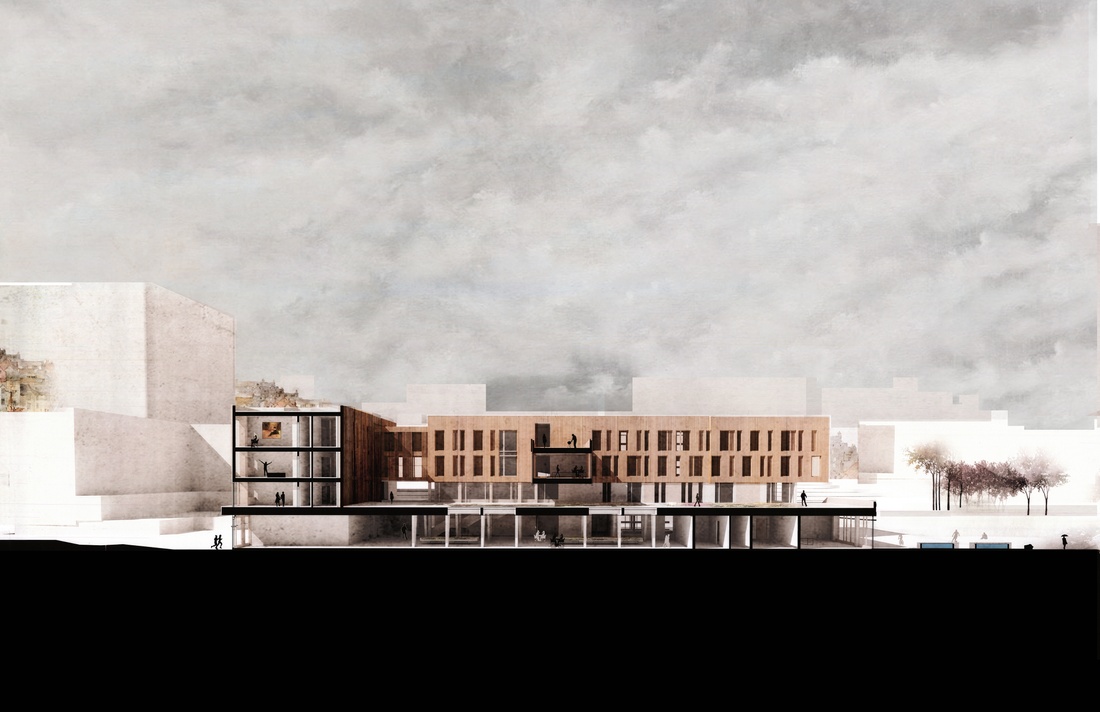
This studio project—the design of an urban distillery—takes place within the context of a growing demand for locally-grown, sustainable agriculture, and the emergence of a market for artisanal premium food products, including small-batch bourbons. We will design a 60,000sf facility that will include spaces of production and storage, a testing and training lab, offices, loading and packaging areas, and a public component to support tours, exhibitions, and events. The studio's design process will begin with an analysis of the various processes and techniques of bourbon production (i.e. grain storage and milling, barrel making and charring, mash cooking, fermentation, distilling, and ageing), a sketch problem that explores the container and its relationship to material and scale, followed by the design of the distillery and its site. The studio will work primarily in section and model.

The site will be a city block in the area of downtown Louisville once known as the "Iron District" and across from an historic block known as “Whiskey Row.” We will study the logistics of material handling, the overlapping paths of goods, workers, visitors, waste, and traffic within the distillery and the city. We will confront the demands of energy consumption, water-use, hygiene, and the pungent odors for which distilleries are infamous. Students will be asked to consider the performative requirements for the architectural envelope in regards to scale, day-light, energy-use, interior climate, brand-identity, and transparency.

During our studio trip to Kentucky we will study the site, stay at the 21c Museum Hotel in downtown Louisville, and visit a number of distilleries, a cooperage (barrel-making) and a still-fabrication facility, meet with bourbon makers, marketers and engineers, and, of course, taste bourbon. We will spend a day visiting the mid-century architecture of Columbus, Indiana including a tour of the Irwin Miller House and see more recent work by Hadid in Cincinnati, Ohio, and works by Eisenman, Graves, Morphosis, and Tschumi on the University of Cincinnati campus. During the semester we will also visit small urban manufacturing and distilling sites in New York City.